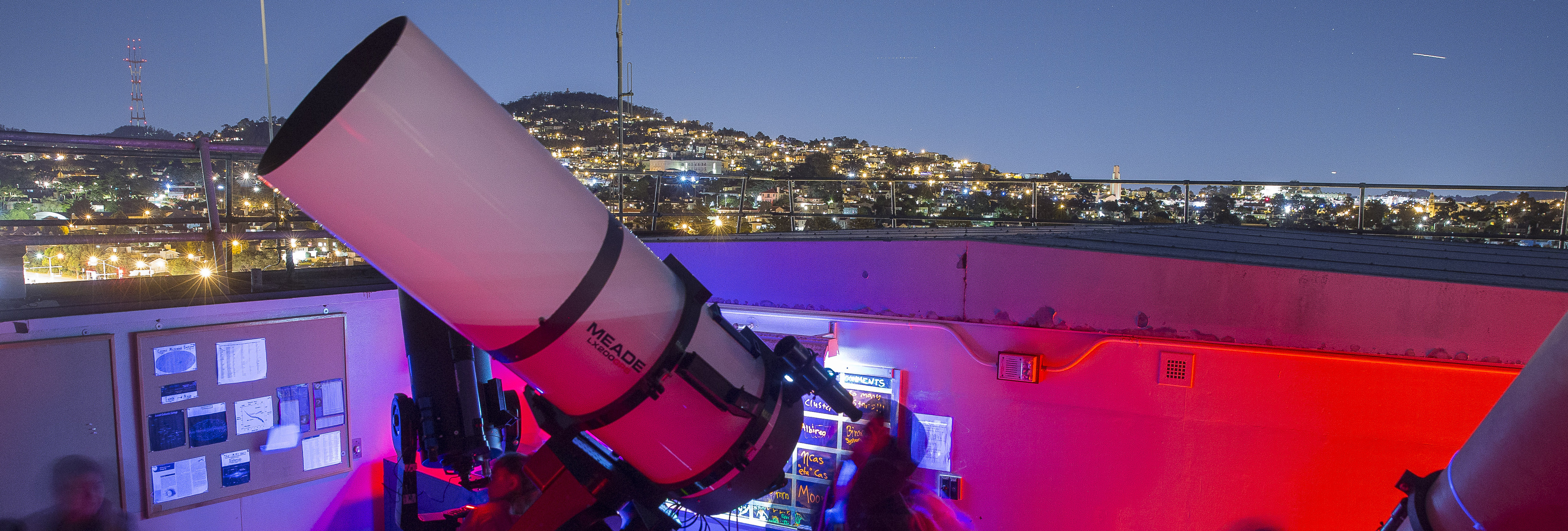
The SF State Observatory is a student-run facility open to all students, staff, and members of the public two or three nights per week in fall and spring semesters. With the aid of observatory docents, visitors use telescopes to look at craters on the Moon, the rings of Saturn, giant star clusters, nebulae created by dying stars, the Andromeda galaxy, and much more. Need a study break? Drop by, and bring a friend!
*** The Observatory is open ONLY when skies are clear! Please see SF State Instagram to check if we are closed due to poor weather conditions! ***
SPRING 2026 PUBLIC OPEN NIGHTS
MONDAY, WEDNESDAY and THURSDAY nights
WHEN SKIES ARE CLEAR
| February 9, 11, 12, 16, 18, 19, 23, 25, 26; March 2, 4, 5 | 6:30 - 9:00 pm |
| March 9, 11, 12, 16, 18, 19, 30 | 7:30 – 9:30 pm |
| April 1, 2, 6, 8, 9, 13, 15, 16, 20, 22, 23, 27, 29, 30 | 8:00 - 9:30 pm |
| May 4, 6, 7 | 8:15 - 9:30 pm |
|
The observatory will be CLOSED for Spring Recess, March 23-27, 2026. The LAST open public night this spring is Thursday, May 7, 2026. |
How can I find out if the observatory will be open?
For up-to-date information about whether the skies are clear and the Observatory is open, check our Instagram! SF State Observatory on Instagram Please note that in case of high winds the observatory may close even if skies are clear.
How do I get to the observatory?
- Take the elevator to the 9th floor of Thornton Hall.
- Find the stairwell close to the elevator.
- Walk to the top of the stairs.
- The door to the observatory will be on your LEFT.
What might I get to see if I visit the observatory in Spring 2026?
- Saturn and its large moon Titan! (early in the semester ONLY)
- Jupiter and its four "Galilean" moons Io, Europa, Ganymede and Callisto (all semester)
- Venus (late in the semester ONLY)
- Orion Nebula (nearest big stellar "nursery"; also known as M42)
- Binary star system Gamma Andromedae (beautiful pair with contrasting colors); early in the semester ONLY
- Eta Cassiopeiae binary star system (twin of the Sun but with a low-mass binary companion in an eccentric 472-year orbit!)
- Andromeda galaxy (nearest spiral galaxy to the Milky Way; also known as M31); early in the semester ONLY
- A close-up view of the Moon and its many craters (whenever the Moon is up!)
Visit Us
Thornton Hall, 10th Floor
San Francisco State University
1600 Holloway Avenue
San Francisco, CA 94132
Questions & Inquiries?
Please contact Jim Gibson (Planetarium & Observatory Staff) at jimg@sfsu.edu or 415-338-6164.